
10 min read
The Customer Experience You Don’t See: How Grid Modernization and Field Service Shape Every Utility Interaction
By: Stacy Schieffer on May 15, 2026 11:17:32 AM
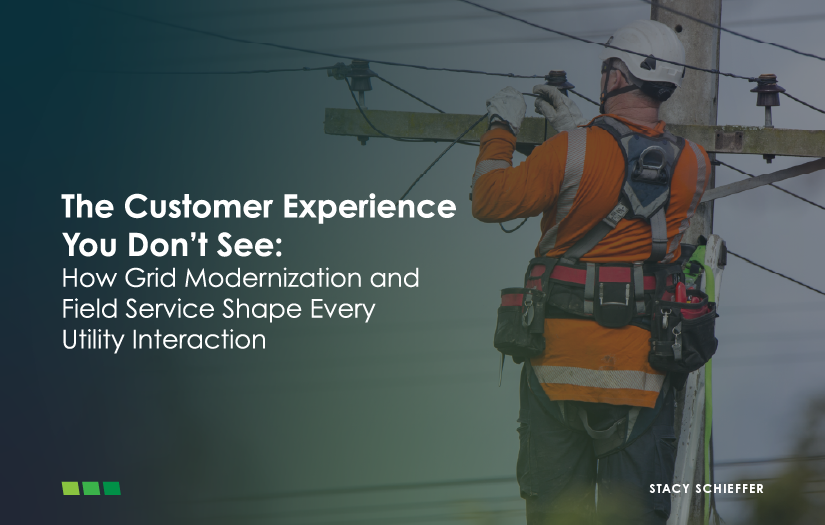
We often hear about digital transformation in utilities in the context of customer self-service, contact centers, and energy programs. These are critical elements of the customer experience. They are visible, measurable, and directly interacted with. What gets less attention are the behind-the-scenes capabilities, grid modernization and field service operations, that shape customer experience in a more fundamental way.
These are the systems and processes that determine:
Whether the lights stay on
Whether outages are avoided or restored quickly
Whether a crew arrives at the right place, at the right time
Whether a new service connection is ready when promised
So why are these areas discussed less often in the context of customer experience? Part of the reason is perception. Grid operations and field service can feel highly technical and engineering-driven, largely invisible to the average customer. If the system works, customers rarely think about it. And within utilities, operational understanding is often considered enough. But that raises an important question: Is “working” enough, or can these processes be improved in ways that benefit both customers and utility teams?
The Hidden Layer of Customer Experience
Grid modernization and field service operations are deeply connected to customer experience, just not in ways customers can easily see.

Most customers do not understand advanced distribution management systems (ADMS), outage management systems (OMS), or grid sensors. What they do understand is:
-
The frustration of an unexpected outage
-
The uncertainty of unclear restoration timelines
-
The inconvenience of missed or delayed service appointments
-
The confusion caused by inconsistent communication
These moments shape trust. Increasingly, they shape expectations.
Where Innovation Makes a Difference
Digital transformation in these areas does not need to be overly complex to create meaningful impact. In many cases, the most valuable improvements are the ones that make the customer experience feel simpler, more reliable, and more predictable.
|
|
|
Customer impact
|
1.Proactive Outage Prevention |
Modern grid technologies such as sensors, automation, and predictive analytics help utilities identify issues before they become outages.
|
Shorter outages and more accurate restoration timelines, reducing uncertainty and frustration.
|
2.Faster, Smarter Restoration |
When outages occur, advanced systems help utilities locate problems faster and dispatch crews more effectively.
|
Shorter outages and more accurate restoration timelines, reducing uncertainty and frustration. |
3.Better Communication When It Matters Most |
Grid and field systems can now feed real-time operational data directly into customer communication channels.
|
Clearer updates, more accurate timelines, and greater confidence that the utility is in control of the situation. |
4.Improved Field Service Execution |
Digital field service tools help crews operate with better information, routing, and prioritization.
|
More reliable service appointments, faster resolution of issues such as meter problems or streetlight outages, and greater confidence that crews will arrive when expected.
|
5.Seamless New Service Connections |
For new construction projects or service upgrades, coordination between grid systems and field operations is critical.
|
Projects stay on schedule, reducing stress for homeowners, builders, and businesses. |
Simpler for Customers, Better for Utilities
These improvements do more than enhance customer experience. They also improve how utility teams operate. When systems are better connected and workflows are streamlined:
-
-
Crews spend less time troubleshooting and more time resolving issues
-
Dispatchers make more informed decisions
-
Engineers gain clearer visibility into system performance
-
This creates a cycle of operational improvement and customer trust: Better tools. Better execution. Better customer outcomes.
The Opportunity Ahead
Utilities have made significant progress modernizing customer-facing systems. The next opportunity is applying the same focus to the operational systems working behind the scenes. Because customers do not separate “front office” from “field operations.” They experience one thing: Did it work? Was it easy? Could I rely on it?

Veracity Point of View
At Veracity, we believe the next phase of utility transformation is not just about improving customer-facing systems. It is about connecting operational execution to the experience customers actually feel.
Too often, grid modernization, field service, and customer experience evolve in parallel rather than in alignment. The result is a disconnect between operational capability and customer perception.
The opportunity is to close that gap.
By aligning grid, field, and customer systems, and by focusing on how work is executed, not just how it is designed, utilities can deliver outcomes that are more efficient internally and more reliable, predictable, and understandable for customers.
In the end, transformation is not measured by the systems implemented. It is measured by how well the entire operation works together when it matters most.